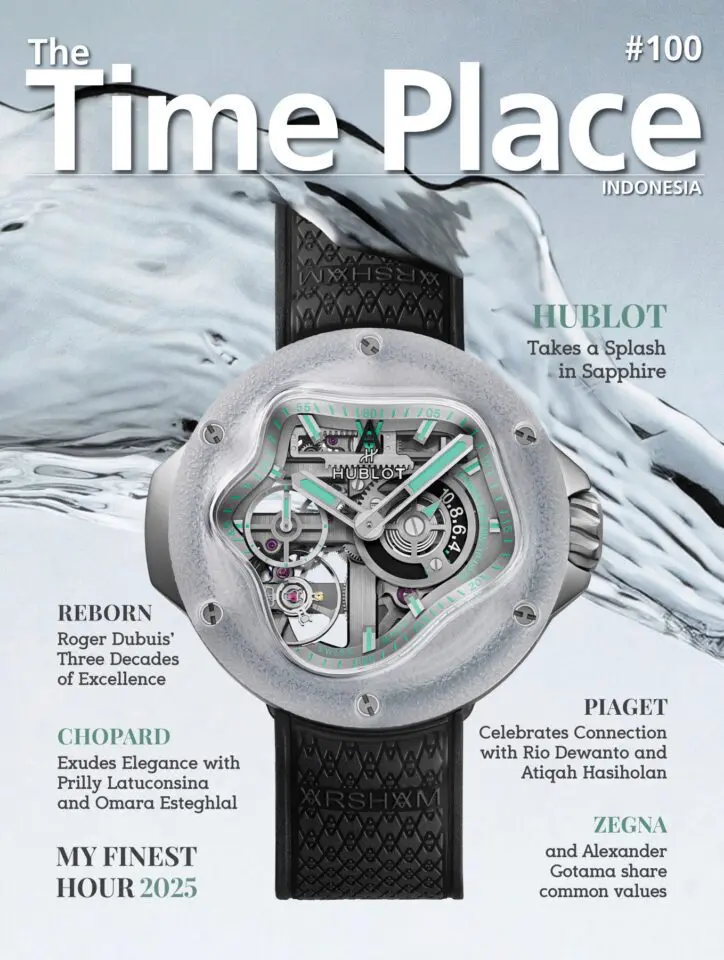
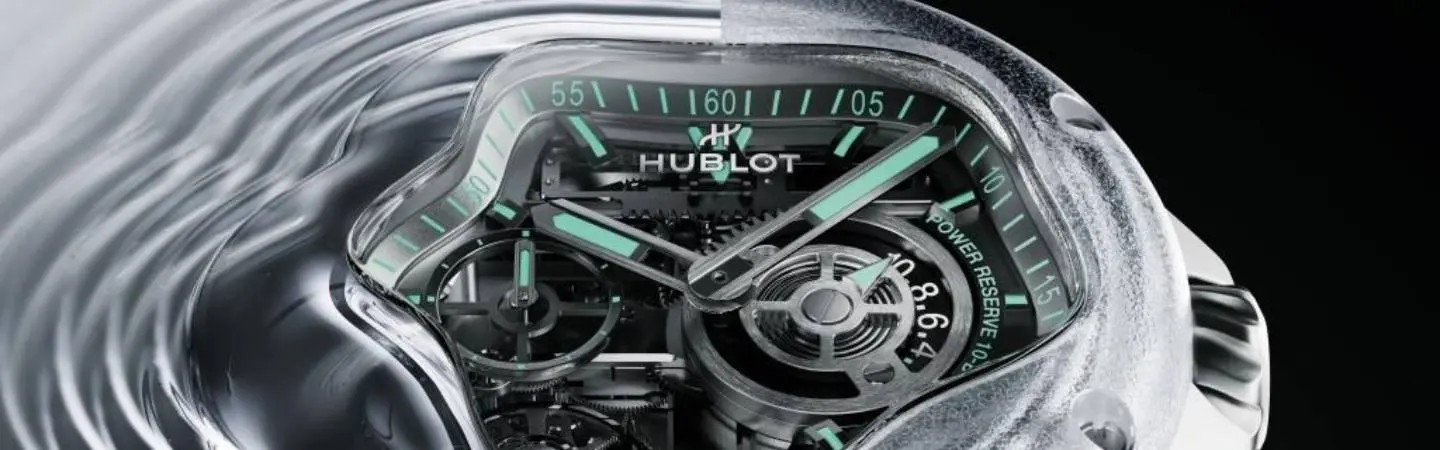
Hublot makes a splash with the second creation from its visionary partnership with artist Daniel Arsham.
by The Time Place Magazine
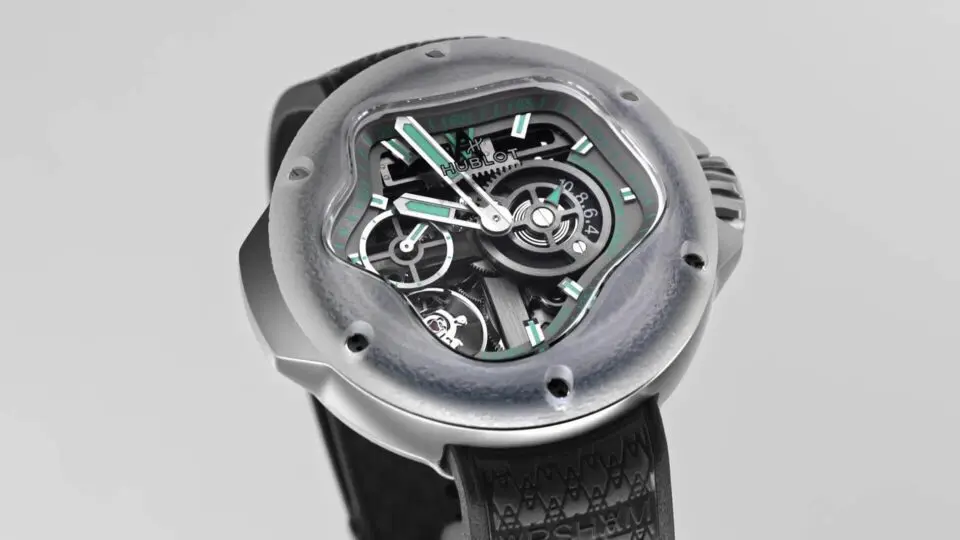
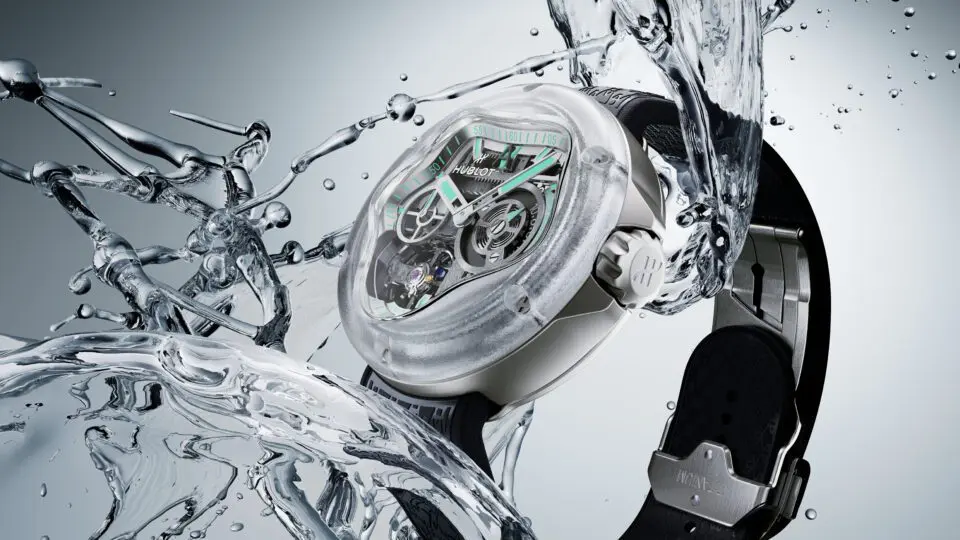
In early October 2025, at 72-13 in Singapore, a building that once served as the Bank of China’s No. 3 warehouse, light and sound converged in rhythm. The interior glowed in shades of silver and mint, mirroring the hues that would define the evening’s centrepiece: the Hublot MP-17 Meca-10 Arsham Splash Titanium Sapphire. When the watch appeared under the central spotlight, the room seemed to focus all at once. Its frosted sapphire surfaces caught the light not as a reflection but as a soft diffusion, like water held midair.
It was an introduction that suited both Hublot and American artist, Daniel Arhsam. Hublot, since its founding in 1980, has lived by a simple but radical principle: the Art of Fusion. To fuse, in Hublot’s vocabulary, is not merely to combine materials but to unite ideas, to treat gold and rubber, engineering and art, as equal partners. That philosophy has guided the brand from the beginning, from the Big Bang to the MP series, evolving into something less about provocation and more about exploration.
Before the “Splash,” there was the Arsham Droplet. Released in 2024, the MP-16 pocket watch marked the beginning of this creative partnership. Inspired by the shape of a single droplet of water, it was an experiment in form and transparency, a sculptural timepiece that seemed to hover between function and art object. Where the Droplet suspended time within a bubble, the MP-17 captures what happens next: the stillness that breaks into motion. Arsham described the two pieces as part of one continuum, “two expressions of the same idea, but viewed through different moments in time.”
Daniel Arsham’s creative origins explain this evolution. Emerging from the worlds of contemporary art and architecture, his works often reimagine everyday objects such as cameras, cars, and even basketballs as crystallised artefacts from an imagined future. He calls this practice “fictional archaeology,” a way of exploring how objects carry meaning across time. His collaboration with Hublot translates that philosophy into mechanics. “The passage of time is both a creative and a destructive process,” he said in the exclusive interview. “That tension is what I wanted to capture here.”
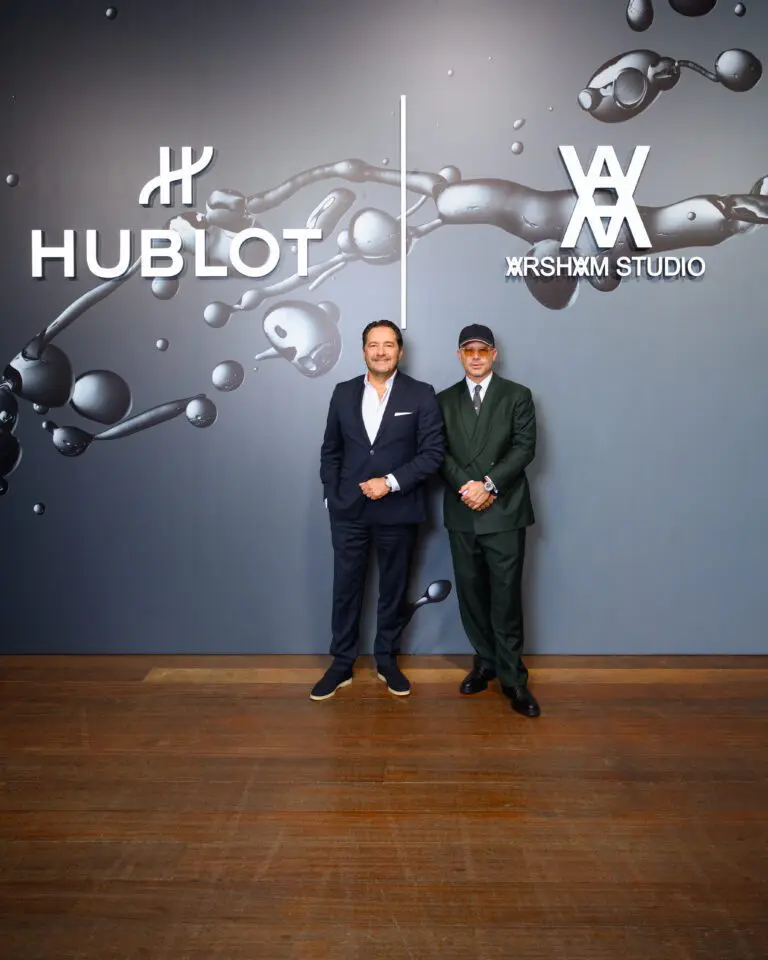
For Hublot, that curiosity was instantly recognisable. The brand has always sought partners who embody a pioneering mindset rather than a shared aesthetic. Hublot’s Chief Executive Officer, Julien Tornare, mentioned that Arsham’s work aligned naturally with Hublot’s spirit of experimentation. “When we look for collaborators, we look for people who challenge perception,” he explained. “Daniel doesn’t just make art, he redefines how we see time. That’s a conversation we understand deeply.”
This shared fascination forms the foundation of the Hublot MP-17 Meca-10 Arsham Splash Titanium Sapphire. It merges mechanical mastery with conceptual depth and poses the same question that runs through the breadth of Arsham’s practice: what if time could be touched, shaped, or even paused?
Art and Horology
At the heart of the watch lies the HUB1205 manual-winding movement, a compact evolution of Hublot’s Meca-10 calibre. Known for its architectural construction and extended power reserve, the movement delivers 10 days of autonomy through twin barrels arranged in parallel. This energy is displayed through a linear rack at three o’clock, a hallmark of the Meca-10 design that visualises time remaining as a measured descent rather than a sweep, making it both functional and philosophical.
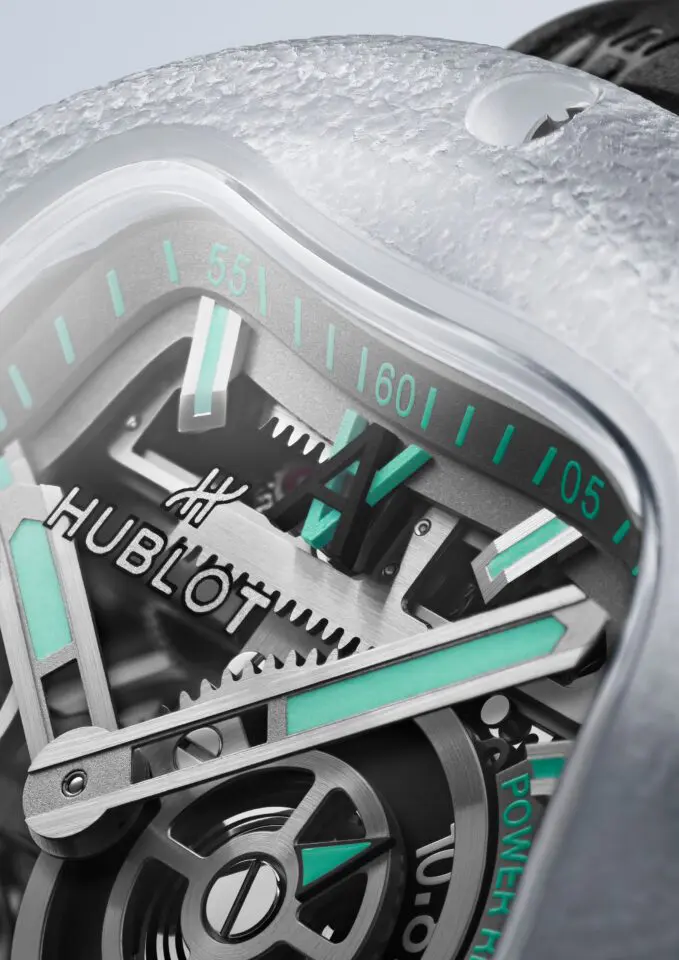
The decision to house this calibre within a 42 mm case required meticulous re-engineering. The original Meca-10 was designed for larger proportions, so every gear, plate, and bridge had to be rebalanced. The titanium case alternates between polished and micro-blasted surfaces, while the sapphire bezel carries a frosted finish that softens its form. This surface effect was discovered almost by chance when Arsham examined an unpolished sapphire sample during prototyping. Instead of discarding the imperfection, he proposed preserving it. The final result became a deliberate texture, a diffusion of light that conveys depth and calm.
That willingness to embrace the unexpected became a theme in their collaboration. In the interview, Arsham recalled how many ideas emerged from experiments that initially seemed like mistakes. “When we started, we didn’t know what was possible,” he said. “There were prototypes that failed, textures that looked wrong, but those accidents led us somewhere new.” Tornare agreed, calling it the essence of innovation: “You need courage to let failure guide you. That’s how Hublot’s best ideas are born.”
From the dial side, the splash-shaped aperture defines the watch’s identity. Its irregular form reveals the skeletonised movement beneath, framed by the structured geometry of the Meca-10. The Arsham Green Super-LumiNova glows across the numerals, hands, and small-seconds display, bridging the visual language of contemporary art and modern horology. The colour, situated between oxidised bronze and mint, speaks to both decay and renewal, which stands as a metaphor for time’s dual nature.
The Texture of Time
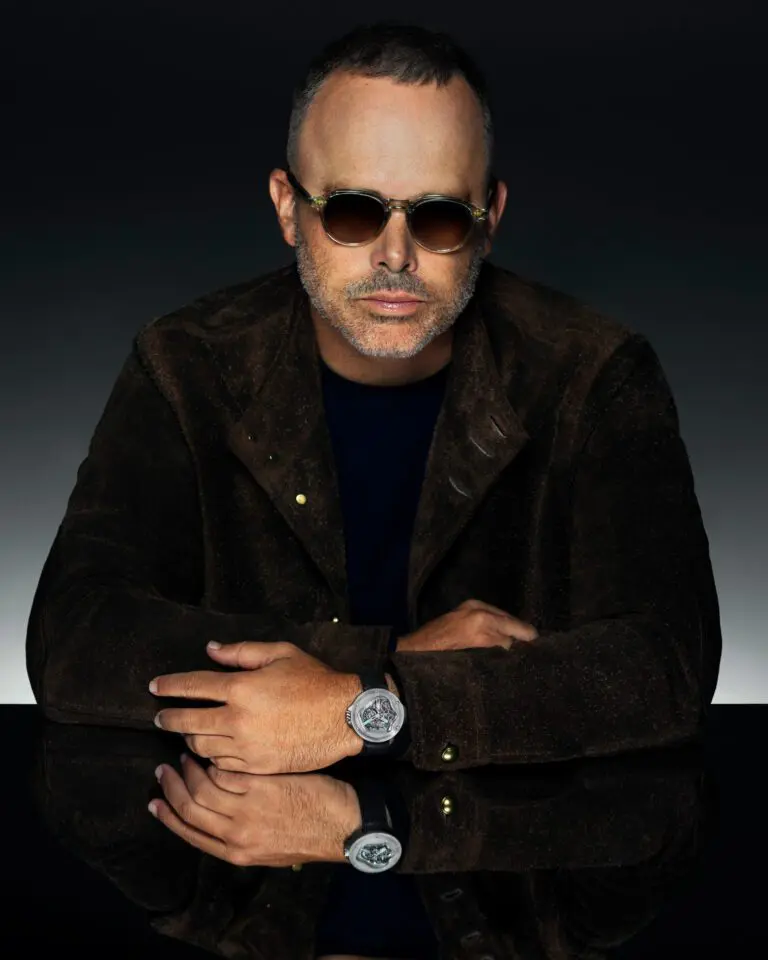
Arsham attended the Singapore unveiling, describing the collaboration as an experiment in freezing movement. “The splash is the moment between creation and stillness,” he explained. “It’s unpredictable, but also precise. That’s what fascinated me about working with Hublot.”
For Julien Tornare, that dialogue between instinct and discipline defines the brand’s modern identity. “When we work with an artist, we don’t just ask them to decorate a watch,” he said. “We ask them to bring their world into ours and to understand ours in return.” Tornare often notes that Hublot’s relative youth, which is barely half a century, allows it to experiment without the weight of tradition. “We respect codes, but we’re not trapped by them,” he added.
The Hublot MP-17 Meca-10 Arsham Splash Titanium Sapphire continues the story of the brand’s MP, or Manufacture Piece, series, a collection that serves as Hublot’s laboratory for its most ambitious ideas. Earlier MP creations, such as the MP-05 LaFerrari and MP-11, explored the extremes of power reserve, architecture, and material transparency. The collaboration with Arsham extends that legacy but shifts the focus. Instead of technical bravado, its innovation is quieter, its design more deliberate, a study in proportion, precision, and philosophy.
That sense of measured control connects the watch most closely to Arsham’s own art. His works often blur the line between discovery and invention, transforming contemporary objects into imagined artefacts. In the same way, the watch feels both futuristic and timeless, a mechanical relic that holds a paradox central to both disciplines: the desire to measure time, knowing it can never truly be contained.
Hublot’s fusion of materials mirrors Arsham’s fusion of ideas. Sapphire, usually a protective medium, becomes expressive. Titanium, prized for strength, is refined to delicacy. Rubber, once dismissed in luxury, is integral to comfort and design. Together, these elements show how Hublot has transformed its founding philosophy from material innovation into intellectual collaboration.
If the Arsham Droplet explored suspension, then the Arsham Splash explores transformation. The two together form a complete meditation on time: one about stillness, the other about motion. And yet both share a belief that the beauty of time lies not in permanence but in process, in the way ideas, like water, change shape when they meet resistance.
Ultimately, the Hublot MP-17 Meca-10 Arsham Splash Titanium Sapphire is a meditation on the texture of time. It treats time not as a measurement to control, but as a material to interpret. In capturing the fleeting instance a droplet becomes a splash, it transforms an ephemeral event into something enduring. That balance between vision and discipline is what gives this collaboration its lasting strength. It reminds us that true advancement in horology lies not in spectacle or speed, but in depth and understanding when engineering listens to art, and art learns from precision.
#ReadAnywhere the latest issue of The Time Place Magazine